Pages

Friday, 24 January 2014

The Terrible Inevitability of the Past

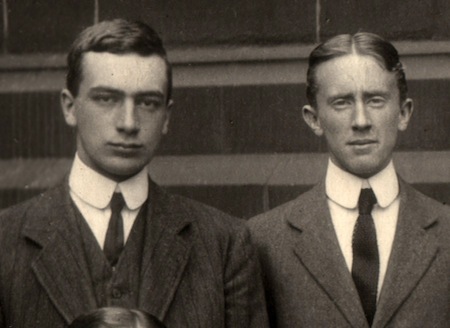
Robert Quilter Gilson was at King Edward's School, Birmingham with J.R.R. Tolkien, part of his close-knit group of friends who called themselves the T.C.B.S. While Tolkien went to Oxford, Gilson went to Trinity College, Cambridge in 1912 to read classics. When Britain entered The Great War in 1914, Gilson entered the Cambridge University Officer's Training Corps, and was shipped out to France with the Cambridgeshires in 1915. A reluctant but beloved officer, Gilson was also a prolific letter writer, to his school friends, his family and his sweetheart, Estelle King, and wrote nearly daily from the trenches. Gilson was killed by a shell while leading his men over the top on the first day of the Battle of the Somme, 1st July, 1916. Friend and fellow officer Andrew Wright wrote to Gilson's father, "It was the final but not the first triumph over his sensitive nature - He alone is brave who goes to face everything with a full knowledge of [his own] cowardice." (Excerpted in Garth, Tolkien and the Great War.)

R.Q. Gilson (left) with J.R.R. Tolkien in 1910 or 1911 (image from www.johngarth.co.uk)
I've been researching Gilson for an exhibition I'm helping to prepare on Trinity and members of Trinity in WWI. I wanted to find someone to focus on who wrote letters from the trenches and could speak, not to a spirit of the age, but for himself, and found Gilson in the pages of John Garth's excellent biography Tolkien and the Great War: The Threshold of Middle Earth. I've been looking through Trinity's archives and other records for mentions of him and have found relatively little, but have had a few nice surprises, for example a drawing he did of the cloisters beneath the Wren Library appeared in Trinity Magazine in 1914 in a section called "Artwork by Undergraduates". The past few days I have been doing this kind of work; chasing leads and scouring records, feeling more like a historian than a librarian for the time being.

Today, as part of my research, I looked Gilson up in the college Admissions Book, mostly to find the name of his tutor, as I already had a fair amount of information about him from other sources. After silently cursing my predecessors for not having students fill in their details alphabetically by surname as I do at the beginning of each Michaelmas Term, I found his entry and was surprised by the emotion I felt on seeing Gilson's details in his own handwriting, his curling script leaning slightly to the left in that upright early 20th century hand. It was as if after the time spent chasing after scraps of evidence of his existence, I turned a corner to meet him face to face. I thought about all the young men and women who I see signing the latest incarnation of the Admissions Book each year and imagined Gilson (I admit, I call him Rob in my head) in the same situation, brimming with possibility and purpose, but in this case I know what lays in store for him, unguessed by any of his peers. He has four years left after writing his details in the regimented columns of this book.

Four years.

Most of what I know of him comes from John Garth's biography of Tolkien, but I have the impression of a generous friend, a kind, caring, eloquent young man with a talent for drawing and painting. He got so little chance to leave his mark, but he left one just the same. I've reached 1914 in the Cambridge Review searching for Rob's name, and behind the articles about donations of books for the Field Hospital in Nevile's Court, Trinity, a Royal visit to the Leys School and sudden anti-German sentiments there are the statistics, the falling undergraduate numbers and the growing lists of names. And each of those names was another Rob Gilson - perhaps not as eloquent or artistic, perhaps not so fiercely beloved - but a young man full of potential.

Lieutenant R.Q. Gilson of the 11th Battalion Suffolk Regiment (known as "the Cambridgeshires" - image from http://www.curme.co.uk/p.htm)
I do not want to argue that World War I was good or bad, or that nationalism is foolish. My own pacifist feelings are, after all, a legacy that this war, the Great War, gave to the modern world. It's as irresponsible to judge people in 1914 for going proudly to war as it is to judge people predating the germ theory of disease for not washing their hands. I have little patience for people who indulge in this kind of retrospective superiority. But I do mourn what these men might have been. I want people who see our exhibition to know of someone like Rob Gilson, to see the awful gap he left in the world when he died in a field near Albert, France in July, 1916.

One has indeed personally to come under the shadow of war to feel fully its oppression; but as the years go by it seems now often forgotten that to be caught in youth by 1914 was no less hideous an experience than to be involved in 1939 and the following years. By 1918, all but one of my close friends were dead.
— J.R.R. Tolkien, forward to The Lord of the Rings
If you want to read more about him, an article excerpting Rob Gilson's letters was written by John Garth and published in Tolkien Studies.

Saturday, 18 January 2014

Book notes #2 - Vision

Andy: Do you have a vision for your book?
Me: ...Yes? As in do I know what I want it to be?
A: Not what you want the content to be, but what you want it to accomplish.
M: Yes.
A: Have you written it down?
M: No.
A: You should write it down.

Andy got this piece of advice from a book he's reading on software start-ups and entrepreneurship. The point of writing a vision down is that the particulars may change as you develop  your company, write your book, change your professional development plan etc., but if you have a consistent vision to refer back to, you will always be progressing in the same direction. The same is true, of course, with strategic planning within existing organisations. While you're slogging it out with the details, getting frustrated, getting sidetracked, you always have the vision to refer back to.

This will probably also help those of you that actually read my previous post figure out what the heck I was on about, and potentially provide me with a useful way to succinctly answer the question I keep getting: "Oh, you're writing a book? What's it about?" This has up until now been followed by a resigned sigh from me as I prepare to launch into a rambling explanation beginning with, "Well, it's a bit complicated to explain..." So I thought I should do this sooner rather than later.

At the most grandiose level, I suppose I want to live in a world where everyone capable of making decisions (especially through voting but also in general) is armed with the tools of critical analysis and information literacy in order to make informed and ethical decisions. I also want readers of my book to question the compartmentalisation of disciplines and not be afraid to make inquiries in unfamiliar territory, transferring the skills and knowledge they have to new contexts. In doing this, readers will challenge the idea that learning takes place only in academic spheres and instead feel empowered to explore and learn independently, and to ask good questions of experts such as teachers, journalists, writers and politicians.

At a more practical level, it should give readers of many different learning styles a primer for understanding how knowledge is constructed in many different disciplines and how it is used in many different formats, so that an artist can pick up a neuroscience article in a newspaper and can understand whether the conclusions are valid, and a mechanic can listen to a political speech and know whether there is an attempt at manipulation, just as two random examples.

The audience I have in mind is explicitly not an academic audience, though it could benefit people in academia. I haven't decided if I want to write it specifically for pre-teen students or keep adults in mind as well, but I think that's a challenge I can face later. The main thing is that I want it to be engaging, visually interesting (part text book, part infographics, part graphic novel), full of activities and humour as well as really challenging and surprising.

On a personal level, I just want to try to write a book that makes people as excited about learning and investigating as I am. I want to inspire the kind of wonder about learning and information literacy issues that books like the classic Dorling Kindersley books and other such books inspired in me when I was a kid. I'm looking forward to the challenge, and even if it never gets off the ground I'll have had a lot of fun researching it. But some day I want to hold this book in my hands, regardless of what it looks like, and know that I made it.

I hope this makes sense. I'm sure I'll write more on this soon as I appear to be a little bit in the groove of thinking about this stuff.

Friday, 17 January 2014

Book notes #1

In the autumn of last year I got an idea for a book. It's a book I want to read, but it doesn't exist, so, as many writers before me have done, I'm setting out to write it myself. I have only just begun really sitting down to think about it since my course ended at the end of December so these represent some of my first notes. I've written them out by hand and I think I might just transcribe them directly by way of backing them up somewhere other than a flimsy, eminently lose-able Moleskine notebook, in a city where Moleskines outnumber people 3 to 1. (Probably. I'm just making that up.) Feel free to skip this - it's for my own safe keeping, but together these entries may provide an interesting insight into my writing process, or a black box if the project fizzles out.

HWKWWK [my abbreviation for the working title "How We Know What We Know"] - 16/1/14

I spent the evening combing over the shelves of Waterstone's in Cambridge, looking for something useful, relevant or inspiring in some way to my endeavor, but found very little. In some ways this is comforting - apparently there is a niche, and given the prominence and recent proliferation of books on infographics, I think my book will look appealing to fans of that trend. However, I had hoped to draw inspiration from somewhere fairly directly. In the spirit of viewing nothing as a failure as long as it teaches you something, I did at least refine what my book is NOT, and the sort of sources I can safely avoid. I spent a lot of time in the popular science section, systematically disregarding books of 'facts', books about the internet, books about the brain etc. Dawkins' Magic of Reality still looks intriguing but perhaps more comparing science and mythology. One I did consider buying (and stupidly forgot to write down or take a picture of) was a collection of writings by scientists about their discoveries and claimed to be as much about the cultivation of a scientific way of thinking - insight into the scientific mind for 'outsiders'.

Overwhelmingly, however, anything that looked likely was either a compendium of scientific 'facts' designed to sell to the "Brainiac: Science Abuse" crowd with titles like Why Do Men Have Nipples? and taglines like "What your science teacher DIDN'T tell you!" The aforementioned books on infographics have a similar feel: dense with very visual information but with little to link them. It's like reading a novel abridged and posted on Twitter. Are you learning something? Sure. But is it deep learning you can transfer to other contexts? That is doubtful. In some ways, not only is this what my book is not, it's what my book sets out to remedy; the shallow, passive acceptance of facts presented in uncomplicated ways, which authors assume is okay because it's for the 'uninitiated'. Though I suppose it's likely to end up shelved here (or with philosophy?), my book should give people the tools to question this, social science books, news, political arguments, art criticism etc. Emma used the colourful phrase 'crap detector', which is partly true, but it is also about breaking down the idea/assumption that if you aren't part of the discipline you can't deconstruct an argument.

Emma helped me clarify what I mean by this. She said it's about allowing/enabling people to deconstruct an argument by a scientist, for example, on their own terms. As in, it isn't about a mathematician reading a social science paper and saying, 'Well, that was a logical leap and therefore invalid.' Rather it's saying these are the conventions and criteria for validity that this discipline has established. Does it meet those criteria? Y/N Where does the argument break down? Tied to this are the epistemological questions: are there really 'facts'? If so, why do 'facts' change over time? What is knowledge? What can we know? But there's also the practical element of giving people a key to the maps of different disciplines and conventions, such as academic writing, journalism, infographics etc.

This feels like an absolutely monumental undertaking and it is ambitious in the extreme, but it isn't intended to be a definitive work on any of the topics; I intend to provide a lot of suggestions for further reading. However, it should be a useful and engaging starting point. My own starting point may be with something like intellectual histories of disciplines - historiography, history of philosophy, history of science, history of criticism, etc. - as well as books on conventions for journalism, academia etc. and books on rhetorical techniques. I want to break down the imaginary barriers between disciplines and make readers feel empowered to investigate and question ANYTHING.
...
[Written later:] Rather than 'peering behind the curtain' [of other disciplines], [the book is about] arguing that the curtain is a false construct and the only barriers to understanding linguistic and conventional assumptions perpetuated to protect specialist knowledge. This is not to say experts are useless or don't exist. On the contrary, [I believe that] they should have the confidence in their own expertise to both allow their work to be questioned and to be able to explain it clearly to individuals who are not aware of the assumptions made in that discipline [e.g. 'outsiders'].
...
[In a list of areas to research:]
- History of epistemology: shows us that what we consider knowable ([within our] paradigm) shapes not only what is 'known' in disciplines but the very idea of disciplines and their relationships to each other [(their layout)]. Removing the assumptions that place FACTS at the centre of knowledge and disciplines at odds with one another allows one the freedom to investigate first principles and underlying assumptions within any framework. However, it's a 'threshold concept' and therefore very difficult to come to terms with, rather like identifying and subsequently questioning privilege. One could say that the current dominant epistemological paradigm privileges expertise and facts over trans-literacies, experiential learning etc. People working w/in that paradigm, e.g. academics, need to question that privilege.
...
"How we know what we know" : The mechanisms through which knowledge is created, both within the current paradigms and how those paradigms came to be.

Thursday, 2 January 2014

Time management: Pay yourself first

A pie chart showing various activities and the time spent on each
Where does the time go? Image by cmcbrown on Flickr


The title of this post comes from my High School Economics teacher, Mr. Shannon. From his list of what I'm sure were very astute financial tips, most of which are long-forgotten, this one has always stuck in my mind most firmly. I found myself thinking about it while considering how I'm going to balance my time over the coming year between work, roller derby, my personal life and working on career development and my book.

The idea behind "Pay yourself first" is this: as you earn money, no matter how small the amount, always put something aside into a savings account before spending it on the month to month costs, a new outfit or whatever (I've not been brilliant at doing this lately, but that is beside the point).

Time management is all about priorities. Of course some priorities are non-negotiable. I will always need to turn up to my full-time job, and I will always need to get exercise. However, it is the negotiable, unstructured time that needs to be carefully managed, particularly if you have some kind of non-work project, skill, etc. that you want to make progress with. It is extremely easy to lose hours to surfing the internet, watching TV, browsing in a bookshop etc. All of that is fine, even necessary sometimes, but it can be the enemy of anything you want to do outside the normal spheres of work, home, friends and clubs/sports/organisations.

That's why I think it's a good idea to "Pay yourself first" - make regularly scheduled time for those other projects like professional development reading, writing your book, perfecting your cooking, practicing piano, or whatever it is you want to make progress with in your own time - and STICK WITH IT. Treat that time as non-negotiable. You may feel like you're missing out on time with friends, or TV you want to watch (seriously, just binge watch it when it comes out on DVD, guys), or whatever, but you picked your priorities so you only have yourself to blame.

My partner suggested that we have a "professional development hour" once a week where we read or write something tangentially job-related and then discuss it with each other. I'm hoping we actually do this because it means that is time during which I can't do anything else but make progress on my own things and I'll have the chance to reflect by talking to my very smart and sympathetic partner about it. Hopefully I'll be better at that than the financial version.

Monday, 30 December 2013

LOL My Thesis

My fellow academics should appreciate this Tumblr I've been enjoying today:

LOL My Thesis

Academics submit one-sentence summaries of their theses and dissertations - the more trivial the more hilarious. Some of my favourites are:

Fake science sounds an awful lot like real science, except it’s fake.

Archaeology, University of Cambridge
Read Thesis

...

Rocks that are next to each other in Massachusetts now were also next to each other 400 million years ago.

Geology, Amherst College

...

14th and 19th century Londoners reacted differently to disease because of the shift in dominant cultural paradigms - or, you know, any number of other things.

Religious Studies, Elon University

...

Poetry is, and should be, like noodles.

Comparative Literature, Columbia College Chicago

...

Fox News is lying to us with graphs.

Graphic Design, University College Falmouth

...

So, colonialism.

History, Wesleyan University

Friday, 13 December 2013

Academic Literacies - Part 2

Hey, look at this, I'm actually blogging! It's almost like there's a looming deadline I'm ignoring... As promised, part 2 of my brain dump after job-shadowing Emma Coonan. It ended up being more of an 'End of PG Dip' decompression post, so sorry about that!

It was an auspicious if sub-optimally-timed day when I finally introduced myself to my secret mentor, Emma Coonan (sub-optimal because she's about to leave Cambridge). Thankfully, she seemed quite pleased to have a chirpy little acolyte running around and we have since had some great conversations through email and my job shadow afternoon earlier this week. I won't go into specifics but I wanted to talk about some of the themes we've discussed, my thoughts, and some reflections on where I see my career heading as my final term of my PG Dip Information and Library Management course winds down.

Emma's job at the UL is Research Skills and Development Librarian, which is in theory my dream job. As such, we share an interest in Information Literacy (IL) as well as consternation with some of the ways in which it is taught, measured, ignored, misinterpreted, or under-valued by various parties in higher education. Information literacy is a term with fairly porous edges, but various groups have come up with useful definitions (see CILIP, SCONUL, ANCIL etc.). They all hover around the idea of IL as a range of skills and literacies necessary to succeed in an information-based world through life-long learning and the ability to successfully and ethically search for, evaluate, manage, synthesize, and present information.

I'm currently finishing up an assignment for my PG Dip course that is a literature review of the methods of 10 studies on information literacy (the choice of topic was mine), and I'm looking at studies that have taken various approaches. The most disturbing trend I've noticed is the tendency for researchers to want to qualitatively measure students' IL as a way of evaluating interventions. To quote an email I wrote:
I've been finding with the studies in my literature review that many researchers are looking for very straightforward, quantifiable ways of measuring skills they've just argued in their literature reviews are complex. Some of the assessments are so obviously missing the point of information literacy, for example a multiple choice questionnaire that asks, "If you want to search for journal articles about 'The prevalence of drug abuse in the UK', the quickest way of finding this would be to search in:..." (McKinney, Jones and Turkington, 2011) Of course the answer they're looking for, the "right" answer, is "a bibliographic database" and they make a big deal about the fact that most people said an online search engine before their IL instruction. But if you have the ability to evaluate sources, why on earth couldn't you construct a perfectly thorough search strategy based on search engines, depending on the topic? And asking the same question at the end of the module only proves that you've trained them to parrot back what you think the "right" answer is. But surely this is epistemologically misguided on the part of the researchers to say that there's a "right" and "wrong" answer in information literacy.
This attitude has given rise to things like Project SAILS, a standardized test claiming to be able to measure the complex and individual literacies associated with IL. This reminds me so much of a standardized, multiple choice test in reading I took when I was in high school. I tested at something like a 2nd grade reading level and because that was very obviously not true, they actually brought in one of the people who designed the test to talk to me, have me read a passage and interpret it. I remember it took place in a jungle and there was a sense of tension and mention of someone/something watching from the trees. When I came up with an incorrect but totally plausible answer to what the passage was about (I said I thought it might be about Guerilla warfare, having read about it a few weeks previously), the woman asked me, "Why do you think your score didn't reflect your reading ability?" I told her that I don't think you can measure reading comprehension with a multiple choice test at all. I brought to the passage my own experience, knowledge and connections, just as students bring their own strategies, preferences and interpretations to the practice of academic literacy. That is not something you can pin down with a standardized test.

The state of IL practice in this country is interesting. Relatively few universities have specific IL-based learning outcomes and policies (see Corrall, 2007), but IL encompasses many of the hidden expectations universities have of their students and researchers. And yet, if they are not taught, how are students expected to know about them, let alone practice them and receive the feedback and guidance of teaching faculty one would expect to get for any other academic topic? At the moment there is underwhelming support from universities, despite the fact that graduates who know how to solve problems, evaluate information, contribute to knowledge and present it to a high standard are in demand. It seems that in a bid to gain funding - or to not lose it - from institutions, practitioner/researchers are left with little choice but to try to demonstrate value with exactly the sort of quantitative instruments that de-values information literacy.

It is not across the board. Within higher education there are managers who support the development of IL curricula with more than just lip service, but this is very much dependent on where you are. So it seems as though I'll either have to seek out employers that already support these programmes, or be prepared to fight tooth and nail to get one established.

Reflecting on the last 18 months, I am amazed at how much I have changed. It seems the rapid transformation of the undergrad. years is not solely due to transitional issues of living away from home for the first time, but owes a lot to the intensive intellectual process of digging down into subjects about which you are passionate.. I have changed my ideas radically - or perhaps 'clarified' is a better word - and reached out to seize my burgeoning professionalism with a much clearer sense of what my ideal future in library work is.

  • I want to help people. I want to help them get excited about learning, empower them to be life-long learners and to continue to learn from them.
  • I want to be involved with the IL research community, to encourage good practice and perhaps contribute to the body of knowledge in this field.
  • To that end, I would like to someday do a Ph.D. Maybe the topic will occur to me through work, maybe through keeping up with research in the area, but I feel I want to challenge myself to do such an in-depth research project.
  • I want to write my book - the sort of book on critical thinking that I'd like to read - and I would LOVE to see that book on required reading lists for GCSE or A Levels.

So, I have more than a little ambition, but a lot of inspiration. If I do half of the things on that list I think I'll be able to feel proud of myself.

Watch this space.

Thursday, 12 December 2013

Academic Literacies with LibGoddess, Part 1

Caveat: This is a brain dump post and it is very long. Read at your own risk, and also get a nice big cup of tea before you do.

On Wednesday (11/12/13 - I wrote the date on everything because it was fun) I job-shadowed Emma Coonan (LibGoddess) of the Cambridge University Library and had a fantastic time doing so! I also attended her last class ever at Cambridge, Academic Reading and Writing for first year Engineering Ph.D. students, in order to get a sense of the kind of teaching librarians do, how to engage students with information literacy material etc. I'm writing this up as a way of keeping record as well as sharing my experience if anyone else is interested. Part 1 deals with the class and Part 2 deals with my general thoughts on the job shadowing experience, the conversations I had with Emma, and where I see my career going.

The class was held in the evening and was pretty well attended. It seemed like Emma had built up a rapport with the students in her previous sessions, which was very nice to see. I acted as a participant in the class because I thought I might get more out of it that way, but tried to also make some observational notes as we went along. In general, the class was mostly lecture style with slides signposting the main topics, along with two practical activities. I enjoyed the lecturing style as it was pretty casual and spontaneous in feel but still kept to the main points. Overall I noticed that Emma made a point of normalizing difficulty and confusion by pointing to examples of her own struggles and acknowledging differences in study style. It was good to hear that although there are certain practices that are more efficient than others, the strategy and style of research is up to the individual - there is no right or wrong way to study.

Emma began with a brief discussion of context - of why it's worth learning about academic reading and writing. There is an assumption in the UK that if you are at University you know how to read and write. Or perhaps that should be written as 'Read and Write', because there are many hidden expectations in academia and in the UK these are seldom made explicit to students. Two of the students in the class had been taught academic writing, in Austria and America, and Emma invited the group to chip in if they thought 'Hang on, that's not what my supervisor told me to do.' In a way, I was really hoping this would happen because it would have made for a very interesting discussion and it would be interesting to hear how teaching faculty in STEM disciplines handle research skills, but I suppose part of my brain was expecting them to have set a less-than-optimal example, which is a stereotype the members of the class quickly made me question.

She went on to explain that, 'Reading and writing are not separate in academia' - that reading is an active process and that writing is a form of thinking. I'm definitely finding that as I become a more self-reflective learner. I am a fervent note-taker when I'm reading, as I form my own ideas about the significant themes, evidence, etc. and I'm a huge fan of reflective writing as a way of establishing what you think, making sense of an experience and getting out the ideas bouncing around in your head. That being said, I'd never made that direct a connection between reading and writing, so it was a definite light-bulb moment.

At this point, Emma asked us to split into groups and discuss what we find challenging about academic reading and writing. In my group I think I was the only native English speaker and one of 4 women in a group of 5, so that was cool! They were a little reluctant to speak so I got the ball rolling, trying to give a very generic answer, though I realized after the fact that I probably set the tone for the kinds of responses the others gave. (Incidentally, I LOVED having this conversation. It was so cool to hear about the challenges STEM students face and their strategies for dealing with them. I had a really good time getting them to open up about some of their issues and listening to their ideas.) I could write an entire blog post about each of the points the groups came up with, but I'll just do bullet points for now.

Group 1:

  • Technical jargon and reading in a language that isn't your mother tongue
  • Figuring out what the main points of a paper are
  • Deciding which author has the most valid argument (this was stated as 'which one is right' - I'm not sure if this shows a lack of epistemological depth or if this is actually a valid question in STEM. I think that's a very philosophical crux.)
  • Structuring arguments (my trying-to-be-generic contribution)
  • Writing with a particular audience in mind
Group 2:

  • Staying on track, not following distractions
  • Concentration in reading and writing
  • Understanding whether a paper is relevant when you aren't familiar with the concepts
It was interesting how different the answers were. Emma brought these together by discussing the different levels of challenges in academic reading. First, there's the physical demand of getting through the volume of reading. Then there's the question of selectivity: WHAT to read. Finally, there's the analytical stage, determining what lines of argument/methodologies are most successful, etc.

With regards to the first level, Emma noted that you are not expected to read everything, nor should you try. Instead, develop strategic reading. This involves:

  • Getting to the core of a paper's argument as quickly as possible (try to get to the point where you can explain its purpose or main bullet points after 5 minutes of reading)
  • Assessing its value to your work (what can you get out of this? How good is it for your needs on a scale of 'meh' to 'Awesome!'?)
  • Making better notes (captures your response to the author. I'm a pro at this. I have elaborate conversations with authors in my notes.)
  • Skimming! Not just for lazy people anymore! (This helps you maintain a critical distance when you read a paper for the first time so you don't fall for sexy rhetoric. It's not just a time-saver.)
In practice, you do this by first focusing on the skeleton of the text, which is often made easier by academic writing conventions, for example abstracts, headings, figures etc. All of these will give you clues as to why the paper exists and whether it will have value to you. In STEM papers, often you can see all of the relevant material just by looking at the figures/tables. Finally, reading the first sentence of each paragraph will often give you a good idea of the flow of the argument.

I was glad to see that most of these were strategies I already follow, particularly in doing my lit review assignment for Northumbria, as writing about 10 articles on a given topic involves looking at a lot more than 10 articles. However, I did kind of want to speak up and say that if something does slip through this process that ends up being irrelevant, it isn't a wast of time if you consider why it is irrelevant and why it managed to escape your filters. At worst, this helps you focus your search strategy and it may even help you focus your research question.

At this point we did a strategic reading exercise. Emma handed out copies of an academic article (some students had brought their own) and she gave us 5 minutes to practice strategic reading. At the end of the 5 minutes we were all able to say very roughly what the articles were about. I'm pretty sure all of us used different tactics. I was probably the most prolific note-taker, but that's what print-outs are for! I noticed I was still using some strategies left over from the literature search for my lit review, as right after looking at the conclusion paragraph, my eyes went to the bibliography and noted with slight derision that they only cited a paltry three sources although they presented no original data. For shame! (Just kidding.)

This brought us to academic writing, because the conventions we'd just used to read strategically are the same conventions we're expected to use in academic writing. They are effectively hand-holding techniques to bring your readers along and tell them the WHAT, WHY and HOW of your paper in the clearest terms possible (see the handout linked below). This portion seemed a lot more extemporaneous, with a lot more examples from Emma's own experience as an academic, probably because the writing process differs so wildly between individuals. She observed that academic writing and research is half Project Management, half crazy creative mess, and you need to allow yourself both. I especially need to remember to allow myself the necessity to be creative and messy when writing for myself. There was also the fairly standard advice to Ph.D. students: start writing now, don't get hung up on the end product, etc.

Finally, we were given the chance to free-write for 8 minutes. I had forgotten how terrifying/fun that is. I do reflective writing from time to time for my own benefit, but it's fun to have the pressure of not being able to stop or edit, as I'm the sort who will spend 20 minutes re-writing the same sentence before I've finished writing the paragraph.

I left the class feeling I'd had a good mixture of reinforcing things I already knew and getting inspired by new ideas. It does make me want to do a Ph.D. at some point. If I ever do, I'm going to try the technique of reading my own writing using the strategic reading method to see if I sign-post as well as I should. I suspect I don't. I also found the tip of looking at the Manchester Academic Phrase Bank for some non-copyright linking phrases to use when stuck VERY useful.

Next time: my random-ish thoughts on the shadowing experience, conversations I had with Emma and where I see my career going from here.

Emma's write-up on her class: http://researchcentral.wordpress.com/2012/04/23/academic-reading-and-writing/
'How to read 10 books (or thereabout) in an hour' handout: http://www.lib.cam.ac.uk/courses/Documentation/10_books_an_hour.pdf
'Academic writing survival guide' handout: http://www.lib.cam.ac.uk/courses/Documentation/essay_writing.pdf